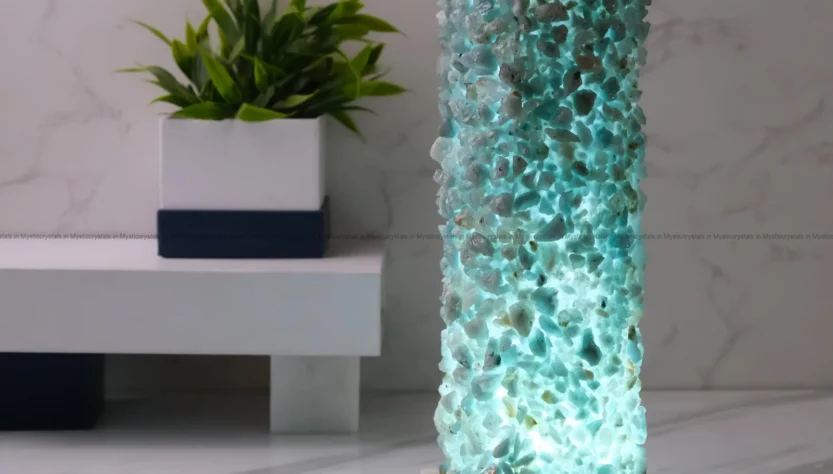
Amazonite is a green to blue-green variety of microcline feldspar valued for distinctive colour and natural patterning. Specimens may appear pale green, turquoise-green, mottled, streaked with white, opaque, or partly translucent. Its spiritual meanings belong to metaphysical traditions rather than scientific evidence, so selection should also consider form, authenticity, durability, and intended use.
What Amazonite Is and How It Looks?
Amazonite belongs to the feldspar mineral group and is commonly described as a green to blue-green variety of microcline. Its appearance varies, so authentic pieces need not share one exact shade or pattern.
Common visual characteristics include:
- pale green, blue-green, or turquoise-green colouring;
- white streaks, patches, or mottled areas;
- opaque to partly translucent sections;
- uneven texture on raw specimens;
- smoother colour and pattern visibility after polishing;
- natural variation between pieces.
Consequently, colour alone cannot establish identity. A bright green stone may be genuine, treated, dyed, imitated, or incorrectly labelled, while a paler specimen can still be natural. Reliable identification therefore matters more than one visual feature.
Amazonite appears as raw crystals, tumbled stones, beads, cabochons, carvings, pendants, bracelets, and other jewellery forms. Polishing can enhance colour and sheen without making every piece uniform.
Traditional Meaning and Symbolic Associations
Within modern crystal practices, amazonite is traditionally associated with calm communication, self-expression, balance, truthfulness, personal boundaries, and thoughtful decision-making. Some practitioners also connect it with emotional steadiness and expressive confidence.
Therefore, amazonite should not be presented as a substance that scientifically changes emotions, improves communication ability, blocks harmful radiation, or produces predetermined outcomes.
People may use it as a symbolic reminder of intentions such as:
- speaking clearly without unnecessary aggression;
- pausing before difficult conversations;
- reflecting on personal boundaries;
- expressing thoughts with greater care;
- balancing openness with thoughtful judgement;
- approaching decisions with a calmer mindset.
The stone itself does not create these behaviours. However, a visible object connected with an intention can become part of a mindful routine.
Practical Ways to Use Amazonite
For example, a polished stone can sit beside a journal, while a tumbled piece can serve as an intention reminder.
Common non-medical uses include:
- holding a stone during meditation or quiet breathing;
- keeping amazonite on a desk;
- wearing suitable pieces as jewellery;
- placing a polished specimen in a reflection area;
- carrying a small tumbled stone;
- pairing the stone with journaling or intention setting;
- using carved or polished pieces decoratively.
Wearability depends on craftsmanship, setting quality, and protection from knocks.
Choosing Amazonite for Your Intended Use
A raw specimen may suit display, while a polished piece is generally more comfortable for carrying. Meanwhile, beads and cabochons suit jewellery when properly finished and securely set.
Consider these factors before choosing:
- preferred shade and natural pattern;
- raw, tumbled, polished, carved, or jewellery form;
- size and weight;
- surface finish;
- visible chips or fractures;
- intended frequency of handling;
- durability requirements;
- care needs;
- craftsmanship in mounted pieces;
- budget and visual preference.
For decorative use, attractive patterning may matter most; for jewellery, polish, shape, structural condition, and setting quality may deserve greater attention.
Purchasing and Authenticity Checks
Anyone planning to buy amazonite crystals online in India should compare actual dimensions, representative imagery, product descriptions, treatment disclosures, and return information before ordering.
Useful purchasing checks include:
- confirm whether photographs show the exact item or a sample;
- compare dimensions and weight where provided;
- inspect colour, pattern, polish, cracks, and chips;
- look for disclosure of dyeing, coating, composites, or other enhancements where relevant;
- review seller-provided origin information when available;
- compare prices for similar sizes and forms;
- check return or replacement terms;
- ensure jewellery descriptions mention size and construction clearly.
However, imperfections do not automatically prove authenticity. In contrast, extremely uniform colour can justify closer scrutiny, but uniformity alone does not prove imitation either.
Consequently, accurate labelling and transparent product disclosure provide more useful evidence than simplistic home tests.
For buyers comparing finished pieces, craftsmanship deserves attention from mineral appearance. A polished cabochon should have even surface suited to design, while beads should have clean drill holes and jewellery settings should hold stones securely. Meanwhile, raw pieces may show irregular edges or matrix material. These features affect usability and presentation rather than metaphysical value. Therefore, judge quality according to intended purpose instead of assuming that brighter colour, larger size, or higher polish always means a better specimen.
Care, Cleaning, and Storage
Therefore, gentle care helps preserve loose stones and jewellery.
For routine care:
- wipe the surface gently with a soft cloth;
- avoid harsh household chemicals and abrasive cleaners;
- protect pieces from hard knocks and repeated drops;
- store amazonite separately from harder jewellery when practical;
- keep carved edges and thin pieces away from pressure;
- inspect jewellery settings periodically for looseness.
Avoid assuming that prolonged soaking, saltwater exposure, chemical cleaning, or aggressive scrubbing suits every piece. Additionally, treatments, settings, adhesives, and mixed-material jewellery can require different care from an unmounted natural stone.
Keeping Expectations Realistic
Amazonite can hold personal or symbolic meaning within meditation, mindfulness, journaling, and spiritual routines. Some people use its colour and associations as reminders of communication, reflection, or boundaries.
However, amazonite does not scientifically regulate emotions, remove toxins, improve mental health, protect against electromagnetic exposure as a medical measure, or guarantee confidence and truthful communication. Practical change depends on behaviour, communication skills, reflection, supportive relationships, and professional assistance when appropriate.
Conclusion
Amazonite combines distinctive feldspar characteristics with symbolic meanings that crystal practices connect with communication, balance, and reflection. Practical selection should begin with mineral identity, colour variation, pattern, form, condition, and intended use. Moreover, buyers benefit from checking measurements, photographs, treatment disclosures, craftsmanship, and return information instead of relying on appearance alone. Gentle handling and sensible storage help protect the stone, while realistic expectations keep spiritual symbolism separate from scientific or medical claims.