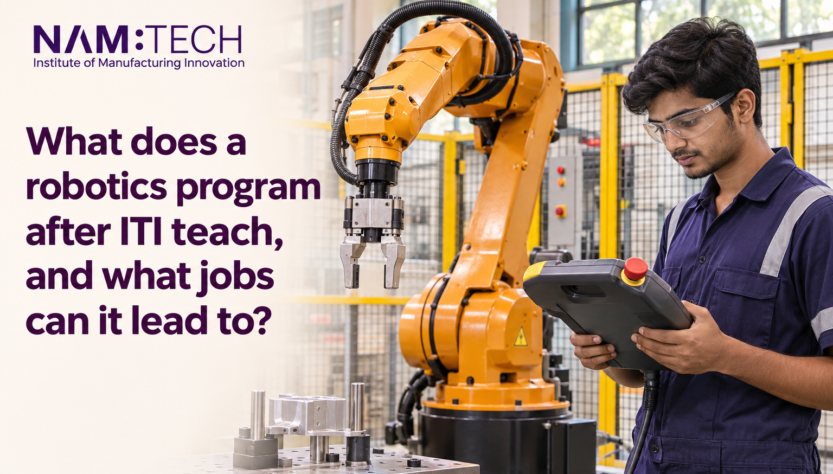
A robotics program after ITI teaches you how to operate, programme and troubleshoot the equipment that makes up an industrial robot cell. You practise moving a robot arm, setting up sensors, working with programmable logic controllers and diagnosing faults safely. That training can prepare you to apply for roles such as robot operator, robotics technician trainee, automation technician trainee or maintenance technician. Your ITI trade, practical experience and the employer’s hiring criteria help determine which roles you can pursue.
What do you study in a robotics programme after ITI?
A robot cell is a work area where a robot and supporting equipment carry out a task together. It may include a robot arm, a gripper, sensors, a conveyor and a control panel. Each component has a specific job. Practical training shows you how these parts communicate and what happens when one fails to respond.
Robot operation and programming
You start with the parts of an industrial robot, including its joints, controller and end effector, the tool attached to the arm. A gripper might pick up a component, while a welding torch follows a seam.
In supervised sessions, you use a teach pendant, a handheld controller, to move the robot, save positions and run a simple sequence. In a pick-and-place exercise, the arm might approach a part, grip it, move to a fixture and release it. You also work with coordinate systems so you can describe a movement relative to the robot, the tool or the workpiece. A small change in the reference point can affect whether the tool lines up with the part.
Sensors, PLCs and motor control
A programmable logic controller, or PLC, runs the logic that coordinates equipment in an automated cell. For example, a sensor confirms that a component has reached a fixture. The control system checks that the required conditions are met and instructs the robot to start its cycle. The robot signals when it has finished so the next operation can begin.
Lab exercises may cover reading wiring diagrams, identifying inputs and outputs, writing basic control logic and checking how motors respond to commands. In a pneumatic gripper exercise, you can trace the relationship between a control signal, a valve and the gripper’s movement. That sequence helps you narrow down a fault when a component receives a command but fails to move as expected.
Simulation and robot cell integration
Simulation lets you examine the layout and planned movements of a cell before testing on physical equipment. You can check whether a robot can reach the required positions, see where its path might interfere with a fixture and compare different layouts. Some programmes introduce digital twins, digital representations of physical systems that can support testing and analysis.
Integration exercises give those concepts a practical purpose. Imagine a conveyor delivering components at uneven intervals. The robot must wait until a part is present, pick it up and tell the line that the station is clear. Setting up that sequence teaches you to consider both the robot’s path and the signals that let each machine know when to act.
Safety, inspection and fault diagnosis
A robotics course should give you supervised practice in working around moving equipment, recognising hazards and following the site’s safety procedures. Training can cover guards, interlocks, emergency stops and the responsibilities of authorised staff during equipment isolation and restart. You also practise recording alarms and reporting faults clearly during a shift handover.
Consider a robot that stops just before picking up a component. The part may sit outside the sensor’s detection range, the fixture may be out of position or the controller may be waiting for a signal. During a supervised exercise, you check the displayed alarm and review the sequence to identify the last confirmed step. That approach helps you describe the fault precisely and direct the investigation towards the right part of the cell.
How does your ITI trade help you in robotics?
Your trade gives you a starting point. If you trained as a fitter, your familiarity with mechanical drawings, assemblies and alignment can help when working with fixtures and grippers. Electricians can draw on experience with wiring diagrams, motors and control panels. Electronics and instrumentation trainees may find sensor testing and signal checks familiar.
A welder can bring knowledge of joint preparation, welding positions and common defects to a robotic welding cell. A machinist may already know how workholding and part orientation affect quality, which carries over to robot-assisted machine loading.
Use your existing trade to choose an early project. A fitter might model a simple fixture and explain how it locates the part. An electrician might document the input and output signals on a training cell.
What jobs can you apply for after robotics training?
Entry-level work can take you into production, automation support, equipment maintenance or installation. Read the job description carefully, since two employers can use the same title for different work. A robot operator at a welding station, for example, may spend a shift checking fixtures and weld quality. A technician at a system integrator may help test a new cell before handover.
Robot operator or robotic machine operator
Operators run established production cycles, monitor alarms and carry out the checks assigned to them. In a machine-tending cell, an operator may check that parts are ready for loading, record stoppages and inspect finished pieces according to the production plan. This role suits candidates who enjoy working on the shop floor and can follow a consistent process across a shift.
Robotics technician trainee
A robotics technician trainee helps with equipment checks, trial runs and basic fault diagnosis. Under supervision, you may verify whether a gripper responds, check a robot’s taught positions or help document changes after testing. Some employers use titles such as junior robot programmer for roles with more programming duties. Check whether they expect experience with a particular robot controller or evidence of previous programming work.
PLC or automation technician trainee
This role focuses on the controls that coordinate equipment. You may assist with checking whether sensors register correctly, tracing wiring against a schematic or testing how the PLC responds during a production sequence. A conveyor that fails to advance, for instance, may be waiting for a signal from the preceding station. These positions suit candidates who enjoy tracing a fault from what the machine does back to the signals the controller receives.
Maintenance technician or commissioning assistant
Maintenance trainees help with scheduled inspections, fault records and equipment checks after authorised repairs. Commissioning assistants support installation and testing before a system enters production. They may help verify connections, record test results and compile a list of issues for the team to resolve. Maintenance tends to suit those who enjoy finding recurring faults on working equipment. Commissioning may appeal if you want to see how a new cell comes together and can travel to customer sites when the role requires it.
Where can you look for robotics jobs in India?
Start with employers that use robots for welding, machine loading, palletising or material handling. Automotive component manufacturers, engineering plants, packaging lines and distribution facilities can offer different kinds of exposure. Equipment manufacturers and system integrators also hire for assembly, installation, testing and support. A factory role can give you repeated practice on the same equipment, while an integrator may give you experience with several kinds of cells.
When you search, use task-based terms as well as job titles. Try “robotic welding operator”, “automation maintenance trainee”, “PLC technician trainee” and “robotics service technician”. Check the qualifications, shift schedule and any travel requirements before applying. Use local job descriptions to see which tasks and controller brands appear repeatedly. That gives you a concrete list of skills to practise and examples to prepare for interviews.
What does NAMTECH’s Industrial Robotics programme cover?
NAMTECH offers the International Professional Technologist Program in Industrial Robotics as a one-year residential programme. Its published curriculum covers mechanical design using CAD, electrical panel wiring, PLCs and motor control, industrial robot programming with sensors, and pneumatic and hydraulic systems. The programme also covers robot integration, digital twins and mobile robotics, and includes a capstone project and on-the-job training.
For ITI applicants, NAMTECH’s programme page lists a two-year engineering trade, at least 60% marks or an equivalent CGPA in the qualifying programme, and at least 50% in Class 10 from a recognised board. It also specifies the earliest eligible year of completion. Check the criteria for your intended intake and confirm that the institute accepts your particular trade before making an application.
Ask NAMTECH’s admissions team what your on-the-job assignment involves and how staff assess your contribution to the capstone. In a group project, each trainee should be able to explain the work they completed, the decisions they made and how they checked the results.
How can you judge the amount of practical training?
Ask how many hours each trainee spends operating a physical robot or working on a PLC training rig. Lab hours can include demonstrations and group sessions, so find out how groups rotate through the equipment. Ask whether you’ll complete a sequence yourself, test it and diagnose a fault with a trainer.
A practical assessment might ask you to interpret an alarm, read an input and output list or explain why a cell waits at a specific step. For a residential programme, request a fee breakdown that covers accommodation, meals and transport where applicable. Request a placement summary showing job titles, so you can see where previous trainees started and which employers hired them. Then compare the commitment with what you want from your first role.
What should you show employers in an interview?
Prepare one project you can discuss in detail. A straightforward sorting, part-loading or pick-and-place exercise can work well if you explain your contribution clearly. Describe the task, the equipment you used and the sequence you helped test. Then pick one fault you encountered and explain what evidence narrowed down its cause.
For example, a training conveyor may have stopped because a sensor registered a part inconsistently. You could explain how you captured the symptom, checked the signal with your trainer and confirmed that the cell behaved as expected after the authorised adjustment. If you have permission to share the material, bring a labelled diagram or a brief test record.
Frequently asked questions
Do I need coding experience before joining?
For many technician-focused courses, you can begin with basic computer skills and build up to robot commands and PLC logic during training. Ask the provider what it expects you to know at entry and how much time it gives beginners to practise on the controller.
Can I become a robot programmer after ITI?
You can work towards robot programming through operator, technician or trainee roles that involve supervised programming. Employers hiring for independent programming often look for experience with a controller, robot paths, cell integration and testing. Check the qualifications and experience listed in each vacancy.
Can I apply if I completed a one-year ITI trade?
Check the provider’s eligibility rules for the specific course. NAMTECH’s published Industrial Robotics criteria specify a two-year engineering trade for ITI applicants. If you hold a one-year trade certificate, check other courses for their trade and duration requirements before paying an application fee.
What is the difference between a robot operator and a robotics technician?
A robot operator typically runs an established production cycle, carries out routine checks and reports stoppages. A robotics technician helps diagnose equipment faults, test changes and maintain the cell. Duties can overlap, depending on the employer and the level of training and authorisation the role requires.
Conclusion
Choose a course that lets you work with the equipment your target employers use. If you want to run a production cell, prioritise supervised robot operation and routine checks. If you prefer maintenance or automation support, look for exercises that let you trace signals, diagnose faults and explain what you found. Whatever role you choose, make sure you can describe a task you performed yourself and how you verified the result.