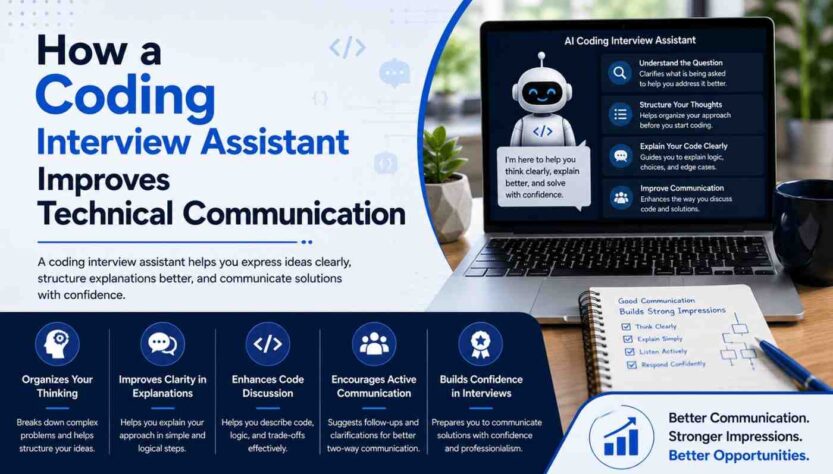
Technical interviews evaluate far more than programming ability. Employers also assess how candidates explain logic, communicate design choices, and respond to complex questions under pressure. Strong communication transforms solid technical knowledge into convincing interview performance. Consequently, many candidates seek structured preparation that sharpens both coding skills and verbal expression. A coding interview assistant supports that goal by encouraging organized thinking, clearer explanations, and confident delivery while preparing candidates for realistic technical discussions.

Why Technical Communication Matters During Coding Interviews?
Technical interviews measure how effectively candidates communicate their reasoning while solving problems. Interviewers often care as much about the thought process as the final solution.
Moreover, software development relies on collaboration. Engineers regularly explain technical concepts to teammates, project managers, and stakeholders with different levels of technical knowledge. Interview performance often reflects those workplace expectations.
Strong technical communication allows candidates to:
- Explain algorithms clearly.
- Present logical problem-solving steps.
- Discuss trade-offs with confidence.
- Clarify assumptions before writing code.
- Respond thoughtfully to follow-up questions.
- Collaborate naturally during technical discussions.
Consequently, candidates who communicate effectively often create stronger overall impressions even when solving challenging coding problems.
How Coding Interviews Have Changed?
Modern technical interviews extend beyond writing syntactically correct code. Employers frequently evaluate communication, analytical thinking, adaptability, and collaboration throughout every interview stage.
Several interview formats have become common:
- Live coding sessions
- System design discussions
- Pair programming exercises
- Behavioral interviews for technical roles
- Code review conversations
- Architecture discussions
Each format requires candidates to explain ideas while solving technical challenges. Therefore, preparation should strengthen both technical accuracy and communication quality.
Communication Influences Technical Evaluation
Interviewers often encourage candidates to speak throughout problem-solving sessions.
Rather than silently writing code, successful candidates typically:
- Describe their approach.
- Explain algorithm selection.
- Identify assumptions.
- Discuss alternative solutions.
- Evaluate time and space complexity.
- Review possible edge cases.
This communication helps interviewers follow the candidate’s reasoning instead of judging only the final answer.
Common Technical Communication Challenges
Many technically capable candidates struggle because they cannot express complex ideas clearly under interview pressure.
Several communication issues appear repeatedly.
Jumping Directly Into Coding
Some candidates begin writing code immediately without discussing their overall strategy.
However, interviewers generally prefer candidates who first explain:
- Their interpretation of the problem.
- Initial observations.
- Possible solution paths.
- Expected complexity.
- Potential constraints.
This structured approach demonstrates organized thinking before implementation begins.
Using Unclear Explanations
Technical knowledge loses impact when explanations become confusing.
Candidates may:
- Skip important reasoning.
- Use vague language.
- Leave assumptions unstated.
- Ignore interviewer feedback.
- Move too quickly between concepts.
Consequently, interviewers may struggle to evaluate actual technical ability.
Speaking Too Little
Silence creates uncertainty during coding interviews.
Interviewers cannot evaluate reasoning when candidates solve problems without verbal explanation. Therefore, consistent communication remains essential throughout every stage of problem solving.
How a Coding Interview Assistant Supports Better Communication?
Structured interview preparation encourages candidates to organize thoughts before answering questions.
Instead of focusing exclusively on coding accuracy, preparation sessions also strengthen explanation quality, logical flow, and communication confidence.
Important areas often include:
- Problem interpretation
- Response organization
- Algorithm explanation
- Technical vocabulary
- Code walkthroughs
- Solution summaries
Together, these improvements create more effective technical conversations.
Building Logical Response Structures
Well-organized answers make technical discussions easier to follow.
Candidates benefit from following a structured sequence such as:
- Restate the problem.
- Clarify assumptions.
- Discuss possible approaches.
- Select the preferred solution.
- Explain implementation.
- Evaluate complexity.
- Consider improvements.
Because each step follows naturally, interviewers can evaluate reasoning with greater clarity.
Encouraging Clear Technical Vocabulary
Technical interviews require accurate terminology without unnecessary complexity.
Preparation helps candidates explain concepts such as:
- Hash tables
- Binary trees
- Dynamic programming
- Graph traversal
- Recursion
- Object-oriented design
Instead of relying on memorized definitions, candidates practice using technical language naturally within complete explanations.
Improving Confidence Through Repeated Practice
Confidence develops through consistent repetition rather than last-minute preparation.
Repeated interview simulations encourage candidates to communicate comfortably while solving increasingly challenging problems.
Furthermore, regular practice helps reduce hesitation during technical discussions.
Benefits often include:
- Improved speaking pace
- Better organization
- Greater clarity
- Reduced filler words
- Stronger analytical communication
- More confident interaction
Each improvement contributes to smoother interview performance.
Reducing Communication Anxiety
Pressure often causes candidates to forget important details even when they know the correct solution.
Structured preparation creates familiarity with interview conversations. Consequently, candidates focus more attention on solving problems instead of worrying about communication mistakes.
Repeated exposure also makes unexpected questions feel less intimidating.
Explaining Problem-Solving More Effectively
Interviewers frequently evaluate the reasoning process rather than only the completed code.
Candidates should explain why they choose one algorithm instead of another.
Helpful discussion topics include:
- Expected efficiency
- Scalability
- Memory usage
- Readability
- Maintainability
- Practical limitations
These conversations demonstrate technical maturity while helping interviewers follow every important decision.
Making Complex Ideas Easier to Follow
Strong communicators divide complicated explanations into manageable sections.
Instead of presenting every technical detail simultaneously, successful candidates often explain:
- The overall objective
- Individual components
- Data flow
- Expected output
- Performance considerations
This organized communication improves clarity without oversimplifying technical concepts.
Strengthening Collaboration During Technical Discussions
Coding interviews frequently resemble workplace collaboration instead of formal examinations.
Interviewers may interrupt with additional questions, suggest alternative approaches, or request design modifications.
Candidates who respond constructively demonstrate flexibility and teamwork.
Effective collaboration includes:
- Listening carefully before responding
- Asking clarifying questions
- Accepting constructive feedback
- Explaining revisions logically
- Maintaining professional communication
These behaviors reflect valuable workplace skills beyond technical expertise.
Preparing for Interactive Problem Solving
Many interview formats involve continuous discussion throughout the coding exercise.
Rather than treating interruptions as obstacles, candidates should view them as opportunities to demonstrate adaptability.
An online AI coding interview assistant can provide realistic practice scenarios that encourage candidates to explain decisions while adjusting their solutions naturally, helping technical communication become more structured and confident.
Communicating Code With Greater Clarity
Strong coding ability creates value only when interviewers can follow the candidate’s reasoning. Clear communication connects every step of the solution and demonstrates organized thinking.
Moreover, structured explanations help interviewers evaluate technical knowledge without making assumptions. Candidates who communicate consistently often create more productive interview conversations.
Effective code communication includes:
- Explaining variable choices
- Describing function responsibilities
- Clarifying control flow
- Identifying important conditions
- Highlighting expected outputs
- Summarizing completed solutions
Each explanation strengthens the interviewer’s confidence in the candidate’s technical approach.
Explaining Every Decision
Every coding decision should have a clear purpose.
Instead of simply selecting a data structure, candidates should explain why it suits the problem. Likewise, algorithm selection should reflect efficiency, readability, and scalability rather than personal preference.
Interviewers appreciate candidates who justify decisions logically because those explanations demonstrate thoughtful engineering practices.
Balancing Technical Detail
Too much detail can overwhelm an interviewer, while too little leaves important questions unanswered.
Successful candidates provide enough technical depth to explain their reasoning without creating unnecessary complexity. Consequently, explanations remain informative and easy to follow throughout the discussion.
Answering Follow-Up Questions Successfully
Technical interviews rarely end after the first solution.
Interviewers frequently introduce additional requirements, modify constraints, or ask candidates to improve existing code.
Preparation helps candidates remain composed when facing questions such as:
- Can this solution run faster?
- How would you reduce memory usage?
- What happens with invalid input?
- Which edge cases require attention?
- Can another algorithm solve this more efficiently?
- How would this perform with large datasets?
Thoughtful responses demonstrate flexibility and analytical thinking.
Responding Without Losing Structure
Unexpected questions sometimes interrupt a candidate’s flow.
However, maintaining an organized response helps preserve confidence.
A practical response pattern includes:
- Confirm the question.
- Consider the new requirement.
- Explain the reasoning.
- Present the revised solution.
- Discuss the impact on complexity.
This sequence keeps technical discussions focused even when requirements change.
Improving Whiteboard and Live Coding Communication
Many technical interviews require candidates to solve problems while speaking continuously.
This format evaluates coding ability alongside communication, adaptability, and collaboration.
Candidates should communicate each stage by:
- Restating the objective
- Breaking problems into smaller tasks
- Explaining intermediate decisions
- Reviewing completed sections
- Identifying possible improvements
Consequently, interviewers gain a complete picture of the candidate’s technical thinking.
Thinking Out Loud Effectively
Thinking aloud does not mean describing every keystroke.
Instead, candidates should explain meaningful decisions as they progress through the solution.
Useful discussion points include:
- Why one algorithm fits better
- Which assumptions influence the solution
- Where performance challenges may appear
- How edge cases affect implementation
- Which improvements remain possible
This approach keeps communication relevant and professional.
Improving System Design Conversations
Senior technical interviews frequently include architecture discussions.
Candidates must explain large systems clearly while connecting individual components into a complete solution.
Important communication areas include:
- Service responsibilities
- Database selection
- Scalability planning
- Load balancing
- Caching strategies
- Fault tolerance
Organized explanations help interviewers evaluate both technical knowledge and architectural thinking.
Presenting Architecture Logically
Architecture discussions become easier when candidates explain systems step by step.
Rather than describing every component immediately, they should introduce each layer gradually before explaining how those layers interact.
This structure prevents confusion while demonstrating organized technical thinking.
Strengthening Behavioral Communication for Technical Roles
Technical interviews often include behavioral questions alongside coding assessments.
Interviewers evaluate communication, collaboration, leadership, and decision-making through workplace scenarios.
Candidates should prepare examples involving:
- Team collaboration
- Project ownership
- Conflict resolution
- Technical leadership
- Deadline management
- Continuous improvement
Well-organized responses complement technical performance and present a balanced professional profile.
Connecting Technical and Soft Skills
Technical expertise alone rarely defines successful engineers.
Organizations also value communication, teamwork, accountability, and adaptability.
Candidates who combine technical accuracy with clear interpersonal communication often perform more effectively throughout multi-stage hiring processes.
Avoiding Common Communication Mistakes
Even experienced developers occasionally weaken their interviews through avoidable communication habits.
Common mistakes include:
- Speaking too quickly
- Interrupting interviewers
- Ignoring clarification requests
- Using unexplained technical jargon
- Providing excessively long answers
- Forgetting to summarize solutions
Recognizing these habits early allows candidates to replace them with stronger communication techniques.
Remaining Calm During Difficult Questions
Every candidate eventually encounters unfamiliar problems.
Rather than rushing toward an uncertain answer, candidates should acknowledge the challenge and explain how they would approach solving it.
Interviewers generally value structured reasoning more than immediate perfection.
Building Long-Term Communication Skills
Interview preparation also strengthens professional communication beyond hiring discussions.
Developers regularly explain technical concepts during:
- Design reviews
- Sprint planning
- Client meetings
- Code reviews
- Project presentations
- Cross-functional collaboration
Consequently, communication improvements continue delivering value throughout a technical career.
Creating Consistent Practice Habits
Communication improves through steady practice instead of occasional intensive sessions.
Candidates benefit from routines that include:
- Reviewing previous responses
- Practicing technical explanations aloud
- Refining coding discussions
- Expanding system design knowledge
- Improving response organization
Small improvements made consistently often produce lasting communication gains.
Measuring Progress Throughout Interview Preparation
Strong preparation becomes more effective when candidates evaluate measurable improvements instead of relying on assumptions.
Rather than focusing only on solving more problems, candidates should also monitor communication quality. Consistent evaluation highlights strengths while identifying areas that still require attention.
Useful indicators include:
- Response clarity
- Logical organization
- Speaking confidence
- Technical accuracy
- Time management
- Adaptability during follow-up questions
Reviewing these areas regularly helps candidates make targeted improvements before important interviews.
Tracking Communication Development
Progress often appears gradually through repeated practice.
Candidates should periodically review whether they:
- Explain solutions more clearly.
- Reduce unnecessary pauses.
- Answer follow-up questions confidently.
- Present algorithms logically.
- Summarize solutions effectively.
Tracking these improvements encourages continuous refinement instead of inconsistent preparation.
Preparing for Different Technical Interview Formats
Technical interviews vary significantly between employers and roles. Consequently, candidates should prepare for multiple interview environments rather than expecting a single format.
Different interview styles commonly include:
- Coding assessments
- Pair programming
- System design interviews
- Debugging exercises
- Technical discussions
- Final engineering interviews
Each format emphasizes different communication skills while still requiring logical explanation and professional interaction.
Virtual Technical Interviews
Remote interviews introduce additional communication considerations.
Candidates should prepare by:
- Testing audio and video equipment.
- Maintaining clear eye contact with the camera.
- Speaking at a steady pace.
- Confirming interviewer questions before answering.
- Explaining solutions without unnecessary distractions.
Professional virtual communication creates a stronger impression while supporting productive technical discussions.
Panel Technical Interviews
Panel interviews require balanced interaction with several interviewers.
Candidates should acknowledge each speaker, answer questions directly, and maintain consistent engagement throughout the conversation.
Organized communication prevents responses from becoming fragmented while demonstrating confidence under pressure.
Preparing Beyond Individual Interviews
Interview communication remains valuable long after securing a position.
Software professionals regularly explain technical concepts during collaborative projects, planning sessions, code reviews, and architecture discussions. Consequently, continuous communication improvement supports long-term career growth.
Professional communication benefits many workplace situations, including:
- Technical presentations
- Design discussions
- Project planning
- Mentoring junior developers
- Cross-functional collaboration
- Engineering leadership
Strong communication creates better teamwork while reducing misunderstandings across technical and non-technical teams.
Developing Lasting Professional Skills
Candidates who continue practicing communication often become stronger contributors throughout their careers.
Clear explanations improve collaboration, simplify knowledge sharing, and encourage productive technical discussions. Moreover, organized communication supports better decision-making during complex engineering projects.
Conclusion
A coding interview assistant strengthens far more than interview preparation. It encourages structured thinking, clearer technical explanations, stronger collaboration, and confident communication during challenging discussions. Consistent practice allows candidates to explain decisions logically, respond effectively to follow-up questions, and present technical knowledge with greater clarity. As communication continues improving alongside coding ability, candidates become better prepared for technical interviews and future professional responsibilities.
FAQs
1. How does a coding interview assistant improve technical communication?
It encourages candidates to explain their reasoning while solving problems instead of focusing only on code. Regular practice improves response organization, technical vocabulary, confidence, and logical thinking, making interview discussions clearer and more structured.
2. Why do interviewers evaluate communication during coding interviews?
Software development depends heavily on collaboration. Interviewers assess whether candidates can explain ideas, justify decisions, answer technical questions, and work effectively with other engineers throughout software projects.
3. Can communication affect technical interview results?
Yes. Clear communication helps interviewers evaluate technical ability more accurately. Even strong coding skills may appear weaker if candidates cannot explain algorithms, assumptions, trade-offs, or implementation decisions effectively.
4. Should candidates explain every coding step aloud?
Candidates should explain important decisions rather than every line of code. Describing algorithms, complexity, assumptions, and problem-solving strategies provides valuable insight without interrupting coding progress unnecessarily.
5. How can candidates improve confidence before technical interviews?
Consistent practice, repeated mock interviews, structured explanations, and regular review of communication habits gradually build confidence. Preparation also reduces hesitation during complex technical discussions and unexpected follow-up questions.
6. What communication mistakes should candidates avoid?
Common mistakes include speaking too quickly, remaining silent while coding, skipping important explanations, ignoring interviewer feedback, providing overly complicated answers, and failing to summarize completed solutions before finishing the discussion.
7. Are system design interviews different from coding interviews?
Yes. System design interviews focus more on architecture, scalability, component interaction, and decision-making. Candidates should explain design choices logically while demonstrating organized technical thinking throughout the conversation.
8. Does communication improvement help after getting hired?
Absolutely. Clear communication supports teamwork, technical presentations, project planning, code reviews, mentoring, and collaboration across departments. These skills remain valuable throughout a software engineering career.
9. How often should candidates practice technical communication?
Regular short practice sessions generally produce greater long-term improvement than occasional intensive preparation. Frequent repetition reinforces communication habits while helping candidates respond naturally during technical interviews.
10. What is the biggest advantage of structured interview preparation?
Structured preparation strengthens both technical performance and communication quality. Candidates become more organized, adaptable, and confident while explaining solutions, answering follow-up questions, and participating in collaborative technical discussions.